Mr Anthony Wesley is the latest in a long line of amateur astronomers who have shown the professionals a thing or two. In 1925, Mr Clyde Tombaugh made very detailed drawings of Jupiter and Mars and sent them to the Lowell Observatory. He was offered a job as a junior astronomer and discovered Pluto 10 months later.
In the mid-1970s, American Stephen James O'Meara saw what looked like spokes on the rings of Saturn. He was unable to get his drawings published, as most astronomers believed them to be optical illusions. In 1979, Voyager 1's photographs proved him right.
Mr David Levy has discovered 22 comets. In March 1993, with his friends Eugene and Carolyn Shoemaker, they discovered the Levy-Shoemaker 9 comet orbiting Jupiter. On July 23, 1995, Mr Thomas Bopp, a warehouse worker, was observing the Arizona night sky as was a professional astronomer, Mr Alan Hale, when he spotted a faint, fuzzy object. The comet was subsequently named Hale-Bopp. The Guardian
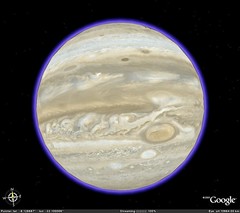
SYDNEY - An Australian amateur stargazer who spotted a "one in a million" impact on Jupiter told of his astonishment yesterday as he chanced upon the Earth-sized dent in its gassy atmosphere.
Mr Anthony Wesley, 44, who has had a life-long passion for the stars, was photographing the planet near midnight on Sunday when he noticed a black mark that had not been there two nights earlier.
The computer programmer, who watches the sky with his 37cm telescope in the backyard of his farm outside Canberra said he first thought it was a shadow cast by one of the planet's 63 moons.
A photo of Jupiter as taken from Canberra on Monday by amateur astronomer Anthony Wesley.
For the next two hours, Mr Wesley frantically photographed the mark, then started emailing astronomers, "to get the professional astronomers in and let them take over".
After Nasa experts spent six hours examining the spot with an infra-red telescope in Hawaii, the verdict came in - Jupiter had been hit, possibly a stray comet or a block of ice which left an Earth-sized dent in its gaseous atmosphere.
Mr Franck Marchis, an astronomer at the Seti Institute said humans should be thankful for Jupiter.
"We should thank our giant planet for suffering for us," he said.
PARIS (AFP) - - Huge geysers on Saturn's moon Enceladus may be fed by a salty sea below its surface, boosting the odds of extraterrestrial life in our own Solar System, according to a study released Wednesday.
This 2006 NASA Cassini space probe mosaic image shows Saturn's moon Enceladus. Huge geysers on Saturn's moon Enceladus may be fed by a salty sea below its surface, boosting the odds of extraterrestrial life in our own Solar System, according to a study released Wednesday.
Researchers in Europe detected salt particles in the volcanic vapour-and-ice jets that shoot hundreds of kilometres (miles) into space, the strongest evidence to date of a liquid ocean under the moon's icy crust.
Scientists already knew that tiny Enceladus, only 500 kilometers across, had two of the three essential ingredients for the emergence of life.
One is an energy source, produced in this case by "tidal warming" driven by the shifting gravitational tug of its parent planet during the moon's lopsided orbit, and perhaps by other forces too.
The Cassini spacecraft circling Saturn since 2004 has also found a potentially life-sustaining mix of organic chemicals in Enceladus' plumes, ejected from a quartet of 120-kilometer (75-mile) long fractures -- known as "tiger stripes" -- aligned on the moon's south pole.
That left the third critical ingredient: liquid water.
Since their discovery in 2005, the giant geysers have fueled intense speculation on the presence of a subterranean ocean, and the new discovery goes a long way toward resolving one of the most hotly debated topics in planetary science.
A team led by Frank Postberg of the University of Heidelberg studied data from Cassini's Cosmic Dust Analyzer, and tested their findings in laboratory experiments.
Their results, published in the British journal Nature, show that ice grains in the Enceladus plumes contain substantial quantities of sodium salts, and that the moon's hidden sea -- if there is one -- could be as salty as Earth's oceans.
"The abundance of various salt components in the particles ... exhibit a compelling similarity to the predicted composition of a subsurface Enceladus ocean in contact with its rock core," the researchers conclude.
"Individual plume sources stay active for years, implying outflow from a large reservoir."
Sodium is a good telltale tracer of possible liquid water for two reasons, according to John Spencer of the Southwest Research Institute in Boulder, Colorado.
It is highly soluble, "so any Enceladan water that has prolonged contact with the moon's silicate core should be rich is sodium salts, like Earth's oceans," he noted in a commentary for Nature.
Sodium also scatters sunlight efficiently in the orange-yellow range of the spectrum, and is thus easy to detect even in minute quantities.
In a second study, also in Nature, a team led by Nicholas Schneider of Colorado University likewise looked for salts in Enceladus' plumes, this time using spectrographs on Earth-bound telescopes.
That it failed to detect any would seem to challenge Postberg's findings, but the Earth-based observations -- combined with the Cassini data -- may in fact give us additional clues as to how they may be true, said Spencer.
It tells us, for example, that the plumes could not have been formed by boiling salty water spewing directly out of Enceladus' tiger stripes, otherwise the sodium would be so abundant as to be observable from Earth.
Instead, the plumes could come from salty water distilling into fresh water vapours, but not through evaporation as happens over Earth's oceans, but rather in pressurised chambers under the moon's surface.
Cassini is scheduled to make four additional up-close fly-bys of Enceladus before mid-2010, and another dozen in the next five years if its mission is extended, so lingering doubts on the moon's hidden seas may soon be put to rest.
This undated handout illustration provided by Nature Publishing group shows what a collision between Earth and Venus might look like. A force known as orbital chaos may cause our Solar System to go haywire, leading to possible collision between Earth and Venus or Mars, according to a study.
PARIS (AFP) - A force known as orbital chaos may cause our Solar System to go haywire, leading to possible collision between Earth and Venus or Mars, according to a study released Wednesday.
The good news is that the likelihood of such a smash-up is small, around one-in-2500.
And even if the planets did careen into one another, it would not happen before another 3.5 billion years.
Indeed, there is a 99 percent chance that the Sun's posse of planets will continue to circle in an orderly pattern throughout the expected life span of our life-giving star, another five billion years, the study found.
After that, the Sun will likely expand into a red giant, engulfing Earth and its other inner planets -- Mercury, Venus and Mars -- in the process.
Astronomers have long been able to calculate the movement of planets with great accuracy hundreds, even thousands of years in advance. This is how eclipses have been predicted.
But peering further into the future of celestial mechanics with exactitude is still beyond our reach, said Jacques Laskar, a researcher at the Observatoire de Paris and lead author of the study.
"The most precise long-term solutions for the orbital motion of the Solar System are not valid over more than a few tens of millions of years," he said in an interview.
Using powerful computers, Laskar and colleague Mickael Gastineau generated numerical simulations of orbital instability over the next five billion years.
Unlike previous models, they took into account Albert Einstein's theory of general relativity. Over a short time span, this made little difference, but over the long haul it resulted in dramatically different orbital paths.
The researchers looked at 2,501 possible scenarios, 25 of which ended with a severely disrupted Solar System.
"There is one scenario in which Mars passes very close to Earth," 794 kilometres (493 miles) to be exact, said Laskar.
"When you come that close, it is almost the same as a collision because the planets gets torn apart."
Life on Earth, if there still were any, would almost certainly cease to exist.
To get a more fine-grained view of how this might unfold, Laskar and Gastineau ran an additional two hundred computer models, slightly changing the path of Mars each time.
All but five of them ended in a two-way collision involving the Sun, Earth, Mercury, Venus or Mars. A quarter of them saw Earth smashed to pieces.
The key to all the scenarios of extreme orbital chaos was the rock closest to the Sun, found the study, published in the British journal Nature.
"Mercury is the trigger, and would be be the first planet to be destabilised because it has the smallest mass," explained Laskar.
At some point Mercury's orbit would get into resonance with that of Jupiter, throwing the smaller orb even more out of kilter, he said.
Once this happens, the so-called "angular momentum" from the much larger Jupiter would wreak havoc on the other inner planets' orbits too.
"The simulations indicate that Mercury, in spite of its diminutive size, poses the greatest risk to our present order," noted University of California scientists Gregory Laughlin in a commentary, also published in Nature.
This undated handout illustration provided by Nature Publishing group shows what a collision between Earth and Venus might look like. A force known as orbital chaos may cause our Solar System to go haywire, leading to possible collision between Earth and Venus or Mars, according to a study.
PARIS (AFP) - A force known as orbital chaos may cause our Solar System to go haywire, leading to possible collision between Earth and Venus or Mars, according to a study released Wednesday.
The good news is that the likelihood of such a smash-up is small, around one-in-2500.
And even if the planets did careen into one another, it would not happen before another 3.5 billion years.
Indeed, there is a 99 percent chance that the Sun's posse of planets will continue to circle in an orderly pattern throughout the expected life span of our life-giving star, another five billion years, the study found.
After that, the Sun will likely expand into a red giant, engulfing Earth and its other inner planets -- Mercury, Venus and Mars -- in the process.
Astronomers have long been able to calculate the movement of planets with great accuracy hundreds, even thousands of years in advance. This is how eclipses have been predicted.
But peering further into the future of celestial mechanics with exactitude is still beyond our reach, said Jacques Laskar, a researcher at the Observatoire de Paris and lead author of the study.
"The most precise long-term solutions for the orbital motion of the Solar System are not valid over more than a few tens of millions of years," he said in an interview.
Using powerful computers, Laskar and colleague Mickael Gastineau generated numerical simulations of orbital instability over the next five billion years.
Unlike previous models, they took into account Albert Einstein's theory of general relativity. Over a short time span, this made little difference, but over the long haul it resulted in dramatically different orbital paths.
The researchers looked at 2,501 possible scenarios, 25 of which ended with a severely disrupted Solar System.
"There is one scenario in which Mars passes very close to Earth," 794 kilometres (493 miles) to be exact, said Laskar.
"When you come that close, it is almost the same as a collision because the planets gets torn apart."
Life on Earth, if there still were any, would almost certainly cease to exist.
To get a more fine-grained view of how this might unfold, Laskar and Gastineau ran an additional two hundred computer models, slightly changing the path of Mars each time.
All but five of them ended in a two-way collision involving the Sun, Earth, Mercury, Venus or Mars. A quarter of them saw Earth smashed to pieces.
The key to all the scenarios of extreme orbital chaos was the rock closest to the Sun, found the study, published in the British journal Nature.
"Mercury is the trigger, and would be be the first planet to be destabilised because it has the smallest mass," explained Laskar.
At some point Mercury's orbit would get into resonance with that of Jupiter, throwing the smaller orb even more out of kilter, he said.
Once this happens, the so-called "angular momentum" from the much larger Jupiter would wreak havoc on the other inner planets' orbits too.
"The simulations indicate that Mercury, in spite of its diminutive size, poses the greatest risk to our present order," noted University of California scientists Gregory Laughlin in a commentary, also published in Nature.

![Reblog this post [with Zemanta]](http://img.zemanta.com/reblog_e.png?x-id=a7cb0531-a443-41f5-a9ed-b9f52250ea4b)



![Reblog this post [with Zemanta]](http://img.zemanta.com/reblog_e.png?x-id=dacc5b4f-e85a-4bd6-b709-9579b898bc7b)

![Reblog this post [with Zemanta]](http://img.zemanta.com/reblog_e.png?x-id=318f071c-4a47-4fe1-ba12-b3060ec73244)

![Reblog this post [with Zemanta]](http://img.zemanta.com/reblog_e.png?x-id=3db89e5d-a24f-4a3e-a3db-ac483c4fc9a0)